
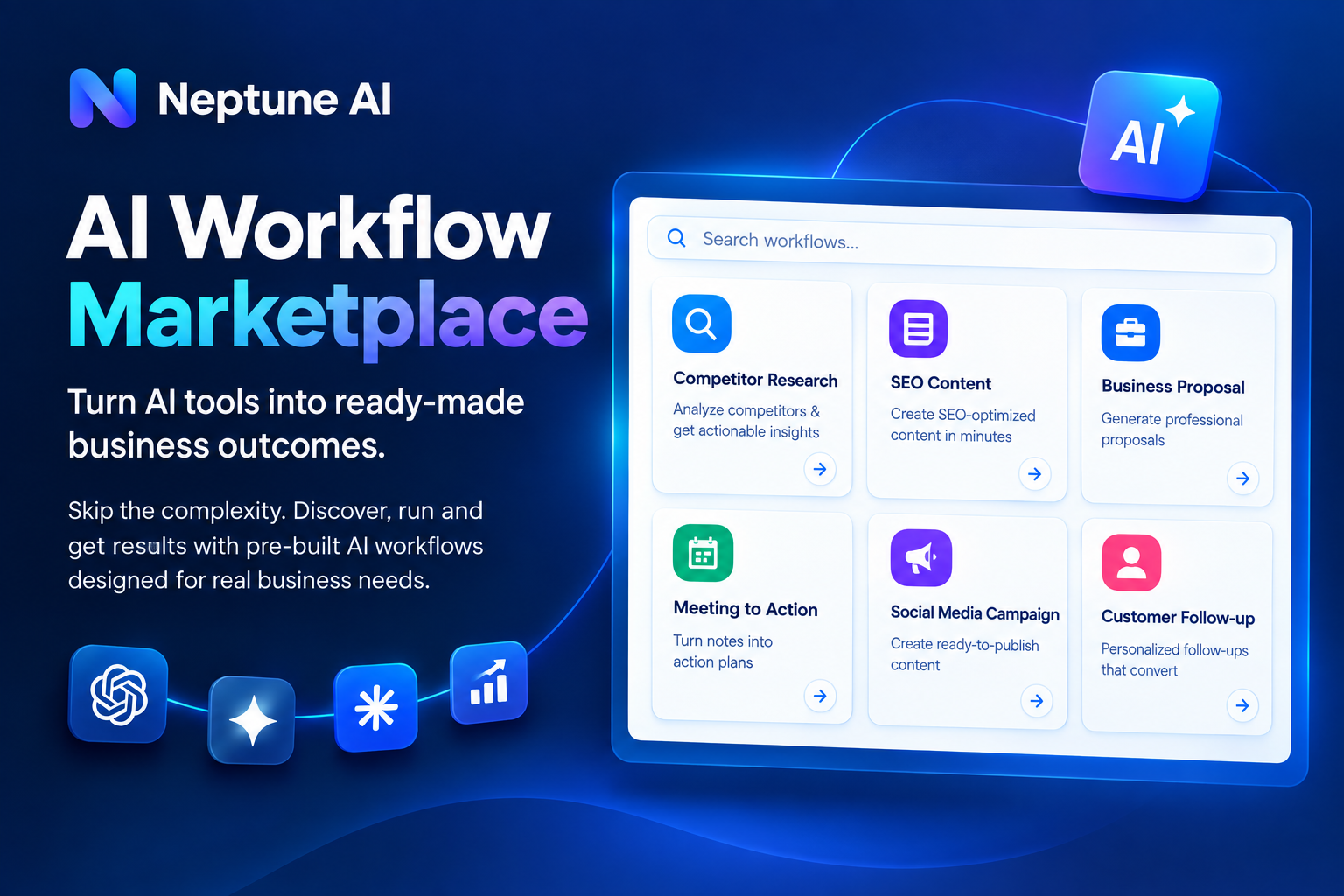
Artificial intelligence has changed the way people research, write, analyze information, communicate with customers, and handle repetitive business tasks. Yet there is an interesting problem hiding underneath all this progress: having access to more AI tools does not necessarily make work simpler. A business owner may have access to multiple AI models, automation platforms, APIs, prompt libraries, communication tools, databases, and integrations, but still spend a surprising amount of time deciding what to use and how to connect everything together. That is where the idea of an AI workflow marketplace becomes important. Instead of making users become experts in AI tools before they can accomplish a task, an AI workflow marketplace organizes artificial intelligence around practical jobs and desired outcomes. A person might simply want a competitor research report, a meeting converted into an action plan, an SEO article prepared for publication, or a customer follow-up campaign created. Rather than asking, “Which AI model should I choose?” the experience starts with a much more useful question: “What do I need to get done?”
Table of Contents
- What Is an AI Workflow Marketplace?
- Understanding the AI Workflow Marketplace
- From AI Tools to AI Outcomes
- Why AI Tools Alone Are Not Enough
- The Problem of AI Tool Fragmentation
- How AI Workflows Actually Work
- From Input to Final Outcome
- What Can an AI Workflow Marketplace Offer?
- Marketing, Sales, and Productivity Workflows
- Practical AI Workflow Examples
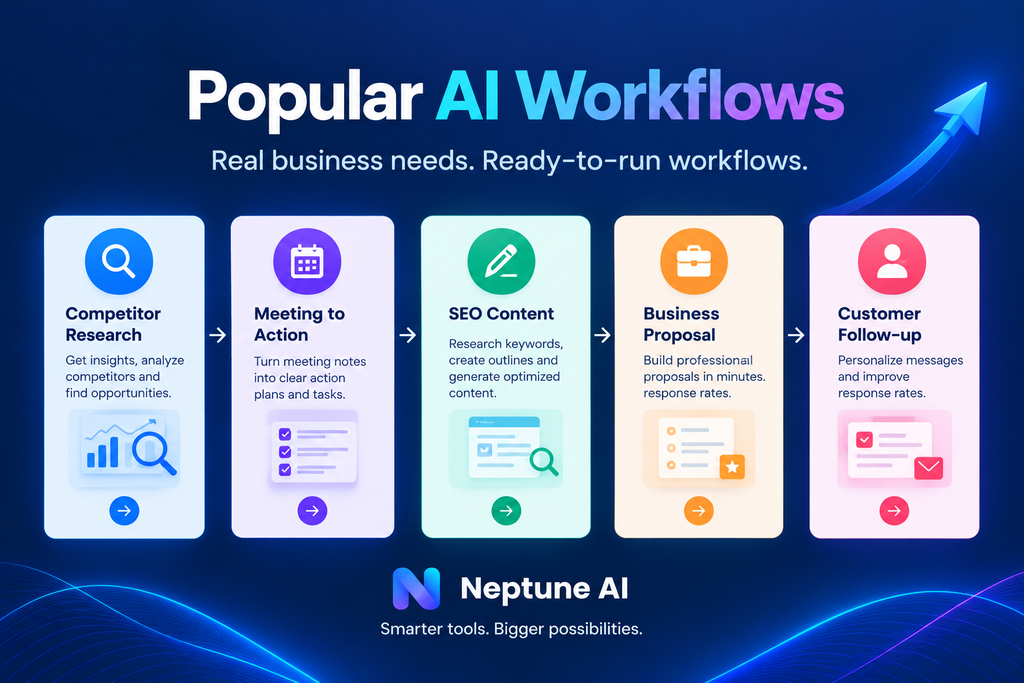
- Competitor Research
- Meeting-to-Action Plans
- SEO Content and Business Proposals
- Why Workflow Reliability Matters
- Execution, Monitoring, and Quality
- How Usage Data Improves Workflows
- The Future of AI Workflow Marketplaces
- How Neptune Approaches AI Workflow Automation
- Conclusion
- Frequently Asked Questions
Understanding the AI Workflow Marketplace
An AI workflow marketplace is a platform where users can discover, configure, and run pre-built AI workflows designed to accomplish particular tasks. The important distinction is that the workflow, rather than the underlying AI model, becomes the primary product. A user does not necessarily need to understand whether a workflow uses one model, several models, an external API, conditional logic, or a communication service behind the scenes. The technical machinery can operate in the background while the user focuses on the desired result. This concept is already appearing across the wider automation market, where marketplaces offer ready-to-use workflows and templates for different business processes. The result is a shift away from thinking about AI as a collection of isolated tools and toward thinking about AI as a collection of repeatable capabilities.
From AI Tools to AI Outcomes
Think of individual AI tools as ingredients in a kitchen. Having flour, eggs, vegetables, spices, and cooking equipment gives you possibilities, but the ingredients do not automatically become dinner. Someone still needs to know the recipe, combine the ingredients in the right order, adjust the process, and decide when the meal is ready. AI workflows work in a similar way. Models, APIs, databases, business rules, and communication channels can all be useful components, but a workflow connects those components into a process that produces a meaningful outcome. A marketplace makes that process easier to discover because users can search according to their objectives rather than technical terminology. Instead of learning which model is best for every individual step, the user can choose a workflow designed for the job and let the system manage much of the complexity.
Why AI Tools Alone Are Not Enough
The rapid expansion of generative AI has created an unusual form of complexity. There are now countless models and specialized applications available, each promising to solve a slightly different problem. One tool may be excellent for writing, another for research, another for automation, another for image generation, and another for customer communication. The challenge is that real business tasks rarely fit neatly inside one application. A competitor research project, for example, might require collecting information, comparing companies, identifying patterns, organizing findings, generating a report, and sending the result to a team. When each stage happens in a different tool, the user becomes the person responsible for connecting the entire process.
The Problem of AI Tool Fragmentation
This is what can be called AI tool fragmentation. The problem is not that individual tools are bad. In fact, many of them are extremely powerful. The problem appears when users have to repeatedly switch between platforms, copy information from one system into another, rewrite prompts, check outputs, configure integrations, and remember how the process worked the last time. A process that looks simple on paper can become surprisingly complicated in practice. A workflow marketplace attempts to hide much of that complexity by packaging the process itself. Instead of building the same chain every week, the user can find a workflow, provide the necessary inputs, execute it, and reuse it whenever the same business need appears.
How AI Workflows Actually Work
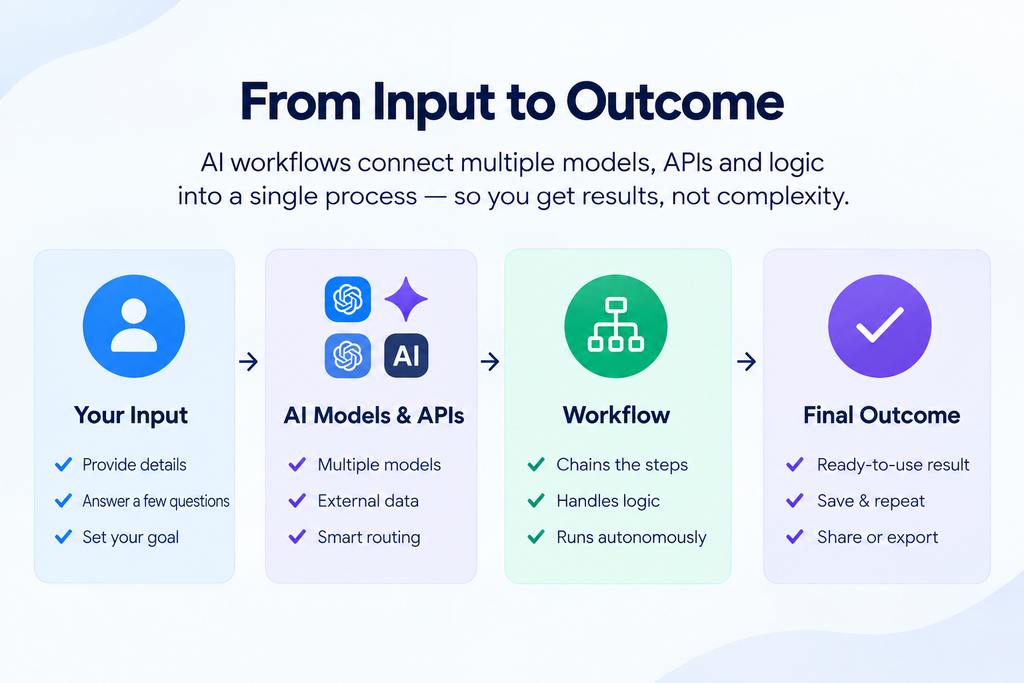
An AI workflow can be thought of as a chain of connected steps where the output from one stage becomes useful information for the next stage. A workflow might begin with a user request, a scheduled event, an incoming piece of data, or an external trigger. It can then send information to an AI model, call an external API, evaluate a condition, transform data, and eventually deliver the result through a communication channel. Modern AI orchestration platforms are increasingly designed around this type of multi-step execution. Neptune, for example, describes its platform as an AI-native orchestration layer that can route and chain AI models and APIs into autonomous workflows. The practical benefit is that users can interact with the process at a higher level instead of manually managing every technical component.
From Input to Final Outcome
Consider a simple competitor research process. Without a workflow, someone might search for competitors, collect websites and information, copy findings into an AI tool, ask the model to analyze the businesses, create a report, edit the report, and finally send it to a colleague. Each step creates another opportunity for delay or inconsistency. With a properly designed workflow, the process can become something closer to Input → Research → Analysis → Report → Delivery. The workflow controls the sequence and passes relevant information between stages. This does not mean every workflow should remove humans from every decision; rather, it means routine coordination can be automated so people can spend more time on judgment, strategy, and decisions that genuinely require human involvement.
What Can an AI Workflow Marketplace Offer?
An AI workflow marketplace can organize automation around the areas where people already spend time. Instead of presenting users with technical categories such as “LLM routing,” “API orchestration,” or “prompt chaining,” the marketplace can use familiar business categories such as marketing, sales, productivity, operations, customer support, research, and content creation. This makes the discovery process much more natural. A marketing manager can look for competitor analysis instead of trying to understand which AI architecture should be used for competitor analysis. A sales representative can search for lead qualification instead of manually assembling a sequence of AI and CRM integrations.
Marketing, Sales, and Productivity Workflows
Marketing workflows might cover SEO research, content planning, social media campaigns, competitor analysis, content repurposing, and marketing reporting. Sales workflows could support prospect research, lead qualification, personalized follow-ups, proposal generation, and sales summaries. Productivity workflows might transform meeting transcripts into action plans, analyze documents, organize research, or prepare structured task lists. Business operations can benefit from reporting, data processing, customer communication, documentation, and repetitive administrative workflows. The key idea is that these categories are based on what people want to accomplish, which makes the marketplace easier to understand than a catalog organized only around technical infrastructure.
Practical AI Workflow Examples
The easiest way to understand the value of an AI workflow marketplace is to look at practical examples. Imagine a business owner who wants to understand five competitors before launching a new service. Traditionally, that person might spend hours gathering websites, copying information, comparing products, analyzing positioning, and preparing a report. A competitor research workflow could turn those steps into a repeatable process. The same principle can be applied to meetings, content creation, sales proposals, customer communications, and many other activities that contain repeated sequences of work.
Competitor Research
A competitor research workflow could begin with a company name, website, industry, or market segment. The workflow could collect relevant information, organize competitor data, compare offerings, identify positioning differences, and produce a structured report. The user would not need to rebuild the research process every time new information is required. This becomes particularly useful for businesses that regularly monitor competitors because the workflow can provide a consistent framework for repeated analysis. The real value is not simply generating text; it is creating a reusable process that turns scattered information into something a decision-maker can actually use.
Meeting-to-Action Plans
Meetings create another obvious opportunity for workflow automation. A transcript or set of notes can contain decisions, responsibilities, deadlines, unresolved questions, and important context, but extracting that information manually can take time. A meeting-to-action workflow could process the transcript, identify key decisions, extract action items, assign responsible people where the information is available, identify deadlines, and prepare follow-up tasks. The important point is that the workflow does more than summarize a conversation. It converts information into actionable work, helping teams close the gap between what was discussed and what actually happens afterward.
SEO Content and Business Proposals
SEO content is another process that naturally contains multiple stages. A workflow could begin with a target keyword and then move through research, search-intent analysis, outline creation, drafting, optimization, metadata generation, and review. A business proposal can follow a similar pattern by collecting client requirements, organizing the proposed solution, developing the scope, preparing the document, and producing a professional final version. When these processes are connected, the user no longer needs to manually coordinate every stage. The workflow creates a repeatable framework while still allowing a person to review and improve the final output.
Why Workflow Reliability Matters
A marketplace cannot succeed simply because it contains attractive workflow cards. The workflows have to deliver useful results consistently. Imagine downloading a workflow that looks perfect but fails halfway through execution, requires unexplained configuration, produces incomplete information, or generates a different structure every time. The marketplace might have thousands of listings, but users will quickly stop trusting it. Reliability is therefore part of the product, not an optional technical feature. A good workflow should clearly explain what it does, what information it requires, what result users should expect, and what happens if something goes wrong.
Execution, Monitoring, and Quality
Reliable execution involves several layers. Inputs should be clear and easy to provide. Individual workflow steps should pass information correctly. External APIs should be handled properly. Conditional logic should route different situations appropriately. Errors should be visible rather than silently breaking the process. Execution logs can help users understand what happened and allow platform operators to diagnose problems. Quality also matters because AI-generated output can vary depending on context and model behavior. A mature marketplace therefore needs a combination of workflow testing, monitoring, user feedback, and continuous improvement rather than assuming that publishing a workflow is the end of development.
How Usage Data Improves Workflows
An AI workflow marketplace can become smarter by learning from how users interact with it. Searches reveal what people are trying to accomplish. Workflow runs reveal which solutions users actually choose. Repeat usage can indicate that a workflow has become part of someone’s regular process. Ratings and feedback can show where users are satisfied and where improvements are needed. Saved workflows can also reveal which processes people consider valuable enough to keep available for future work. When these signals are collected responsibly, they create a useful feedback loop that can guide both product development and marketplace organization.
The Marketplace Feedback Loop
The feedback loop can be summarized as User Need → Discovery → Execution → Feedback → Improvement. Suppose users repeatedly search for a particular business task but rarely find a suitable workflow. That information suggests a gap in the marketplace. If users frequently run one workflow but abandon another after the first attempt, that may indicate differences in usefulness, reliability, or user experience. Over time, usage data can help determine which workflows deserve better placement, refinement, additional integrations, or further development. Neptune’s current platform vision also describes a progression toward routing that can learn from usage data, making data an important part of the broader orchestration strategy.
The Future of AI Workflow Marketplaces
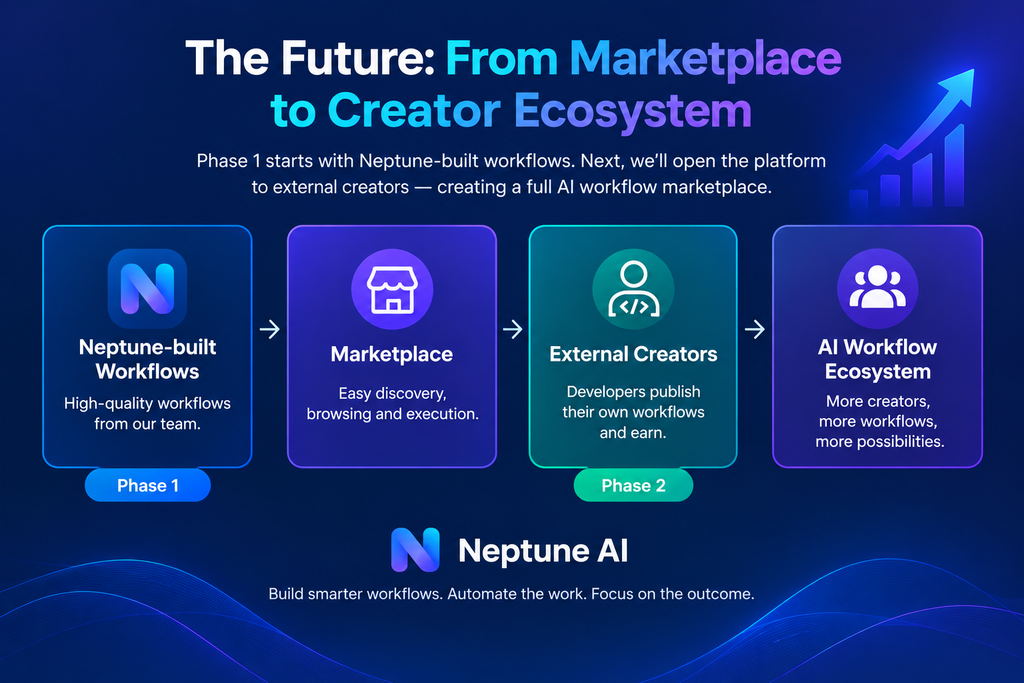
The early stage of an AI workflow marketplace can reasonably focus on workflows built and tested by the platform itself. This gives the company greater control over quality and allows it to understand how people search, configure, execute, and reuse workflows. Once that foundation is reliable, the marketplace can evolve toward a creator ecosystem. Developers, automation specialists, consultants, and domain experts can potentially build workflows for specific industries and use cases. The marketplace then becomes more than a collection of internal tools; it becomes an environment where expertise can be packaged and distributed.
From Platform-Built Workflows to Creator Ecosystems
The creator model introduces an interesting network effect. Creators build specialized workflows, users discover and run them, successful workflows gain visibility, and creators receive an incentive to build even better solutions. Over time, a marketplace can develop a library covering increasingly specific business needs. This model is already visible in current workflow marketplaces that allow creators to publish or sell ready-made automations. Neptune’s current website similarly presents a direction in which developers can publish workflow chains, automation bundles, and communication flows. If this model develops successfully, users may eventually choose an AI workflow marketplace for a particular business outcome in the same way they currently choose an app marketplace for a specific software capability.
How Neptune Approaches AI Workflow Automation
Neptune positions itself as an AI-native orchestration platform rather than simply another standalone AI application. Its current platform description emphasizes intelligent model routing, workflow toolchains, communication agents, and cross-vertical execution. The idea is to create a control layer above models and APIs so that different components can work together as part of a larger process. This approach changes the central question users ask. Instead of beginning with “Which AI model should I use?”, the user can begin with “What outcome do I need?” and then allow the workflow to manage the underlying process.
Intelligent Routing and Workflow Toolchains
Model selection becomes particularly important when a workflow contains several different tasks. One stage might require strong reasoning, another might benefit from a large context window, and another might need fast structured output. Neptune’s platform describes intelligent model routing as a capability for selecting models according to the task, while workflow toolchains connect models, APIs, and logic into larger processes. Communication agents can then help move results beyond the workflow itself by delivering outcomes through supported communication channels. This creates a broader concept of automation: AI is not merely generating an answer and stopping; it can become part of a process that starts with an input and finishes with a useful business outcome.
Conclusion
The future of AI is unlikely to be defined only by which model has the largest context window, the lowest price, or the most impressive benchmark score. For many users, the more important question will be whether AI can help them complete work rather than simply generate content. An AI workflow marketplace addresses that need by packaging models, APIs, logic, integrations, and communication into repeatable processes that people can discover according to the outcomes they want.
The concept also solves a growing usability problem. As the number of AI tools continues to increase, asking ordinary users to become experts in every model and automation platform becomes less practical. Ready-made workflows can act as the bridge between powerful AI infrastructure and everyday business needs. Instead of spending time choosing tools and connecting systems, users can focus on the task itself.
Neptune’s current positioning fits this direction by combining AI model routing, workflow orchestration, APIs, and communication capabilities into an AI-native platform. Its marketplace vision adds another layer: workflows can eventually become reusable products that creators build, users discover, and businesses deploy.
The simplest way to describe the shift is this: AI tools give you capabilities; AI workflows organize those capabilities into outcomes. An AI workflow marketplace takes the next step by making those outcomes easier to discover, use, repeat, and eventually share. As businesses look for practical ways to move from experimenting with AI to actually integrating it into everyday operations, that distinction could become increasingly important.
Frequently Asked Questions
An AI workflow marketplace is a platform where users can discover and run pre-built workflows designed to accomplish specific tasks. Instead of forcing users to select individual AI models, write complex prompts, and connect multiple applications themselves, the workflow packages those steps into a repeatable process. Depending on the platform, workflows may combine AI models, external APIs, business logic, data processing, and communication tools. The user generally provides the required inputs and receives an outcome designed around a particular use case.
An AI tool usually focuses on a particular capability, such as generating text, analyzing information, creating images, or answering questions. An AI workflow can connect several capabilities into a sequence. For example, one workflow might research information, analyze it, generate a report, format the report, and deliver it to a team. The difference is therefore less about the individual AI model and more about how multiple steps are organized to complete a larger task.
Not necessarily. One of the main advantages of pre-built workflows is that users can interact with an existing process without building every technical component themselves. Some workflows may require configuration such as connecting an API key, selecting a communication channel, or entering business-specific information. More advanced platforms can also provide APIs or workflow-building tools for developers who want greater customization. Neptune currently positions its workflow platform around no-code orchestration while also supporting developer-oriented capabilities.
Common examples include competitor research, meeting-to-action plans, SEO content creation, business proposals, lead research, customer follow-ups, reporting, social media planning, document analysis, and administrative automation. The strongest candidates for workflow automation are usually processes that happen repeatedly and contain multiple predictable stages. Instead of recreating those stages manually each time, a workflow can provide a reusable framework. The exact capabilities depend on the marketplace and the integrations it supports.
A successful marketplace needs more than a large number of workflows. Users need useful discovery, reliable execution, clear descriptions, simple configuration, consistent quality, meaningful feedback, and trustworthy creators. The platform also needs to learn which workflows users repeatedly choose and where people encounter problems. Over time, strong marketplaces can use these signals to improve search, recommendations, workflow quality, and creator opportunities. Ultimately, the marketplace succeeds when users can move from “I need to do this” to “Here is a workflow that gets it done” with as little unnecessary friction as possible.
Get More Done With AI Workflows
AI should reduce the amount of time people spend managing technology, not create another layer of technical work. The movement toward AI workflow marketplaces represents a shift from isolated AI capabilities toward ready-made, repeatable outcomes. Instead of asking users to understand every model, API, prompt, and integration, the marketplace can organize those technologies behind workflows built around real jobs.
For businesses, that can mean faster execution, more repeatable processes, and less time spent jumping between disconnected tools. For developers and AI specialists, it can create a new way to package expertise into reusable workflows. And for platforms such as Neptune, it opens the possibility of building an ecosystem where AI models, APIs, automation, communication, and marketplace distribution work together.
The central idea is simple: stop making people figure out the AI stack before they can get the job done. Give them a workflow built around the outcome they actually need.
Explore Neptune AI and learn more about its approach to AI orchestration and workflow automation.
Neptune AI — Build smarter workflows. Automate the work. Focus on the outcome.