
The coordination layer that connects AI agents and keeps them working as one.
What It Is
A multi-agent AI orchestration platform is the coordination layer that sits above individual AI agents and manages how they interact, communicate, and hand off work to each other. It does not replace the agents. It connects them.
Each agent handles a specific task it is best suited for, and the orchestration layer decides which agent acts next, what context it receives, and what happens when something goes wrong. Think of it as an air traffic controller not flying any plane itself, but ensuring every plane takes off, lands, and hands off passengers at exactly the right time.
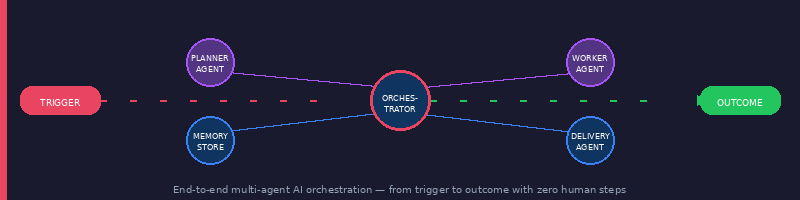
In practice, one platform can receive a trigger, route the task to a reasoning agent, pass the output to an execution agent, apply conditional logic based on the result, and deliver the final outcome all without a human touching it between steps.
Why Single-Agent Systems Are Not Enough
A single AI agent can generate, analyze, or respond. But enterprise workflows rarely involve just one of those things. A customer support request might need context retrieval, policy checking, draft generation, approval routing, and final delivery. One agent handling all of that becomes a bottleneck. It fails on complexity. It loses context across steps. It cannot parallelize tasks that could run simultaneously.
The deeper problem is that as workflows scale, the risk of a single point of failure grows. When everything runs through one agent, a misstep at any stage can corrupt the entire output and there is no separation of concerns to contain the damage.
Multi-agent systems solve this by distributing work across specialized agents:
- One agent researches.
- Another writes.
- A third reviews.
- A fourth delivers.
Each focuses on what it does best. The orchestration platform ensures they work as a single system rather than isolated tools running in sequence.
Core Capabilities Every Platform Must Have
Not all orchestration platforms are built the same. Before choosing one, it helps to know exactly which capabilities separate a production-ready platform from one that only works in demos.
- Task Decomposition and Intelligent Routing
The platform must break a high-level goal into specific subtasks and assign each to the right agent automatically. Without this, orchestration is just manual sequencing with extra steps. Intelligent routing means the system selects agents based on task type, cost, latency, and performance history not a fixed rule written before deployment.
- Shared Context and Memory Management
Agents need to know what happened in previous steps. A review agent cannot give useful feedback without the draft. A communication agent cannot personalize a message without the customer data pulled two steps earlier. Shared memory ensures context flows through the entire workflow without manual passing between steps.
- Agent Coordination and Supervised Handoffs
When one agent finishes its task, the output must transfer cleanly to the next agent with full context intact. Poorly designed handoffs are where most multi-agent systems fail in production. Structured handoffs with state preservation are what separate a working production system from a demo that breaks under real load.
- Workflow Tracking and Observability
Every step in the workflow should be visible, logged, and traceable. This matters for debugging when a step fails, for compliance when an audit is required, and for optimization when a workflow needs to run faster. Platforms without observability are platforms you cannot trust at scale.
- Error Handling and Fault Isolation
Failures happen. A dependent API goes down. A model returns an unexpected output. An agent times out. A strong orchestration platform retries failed steps, reroutes around errors, and keeps the workflow running without manual intervention. Fault isolation means one failing agent does not collapse the entire pipeline.
Multi-Agent Orchestration Patterns
The way agents are arranged and coordinated determines how well the system handles complexity. There are three primary patterns, each suited to a different type of workflow.
- Planner → Worker
A planner agent decomposes the goal and delegates subtasks to specialized workers. Ideal for research, content production, and data analysis workflows where tasks can run in parallel.
- Supervisor
A supervisor agent monitors all others, routes exceptions, and validates quality before the workflow proceeds. Best for regulated workflows where every output needs approval.
- Tool Router
The orchestrator evaluates the task and selects the right tool or model automatically no upfront specification needed. Enables true intelligent model routing at scale.
How Neptune AI Approaches Orchestration
Neptune is built as a native multi-agent AI orchestration platform, not a general automation tool with AI added as a feature. The routing engine selects the optimal model per task automatically GPT-4o, Claude 3.5 Sonnet, or Gemini 1.5 Pro based on task type, cost requirements, and performance history.
Workflow toolchains chain multiple AI steps together, passing full context between each agent in the sequence. Communication agents deliver the final outcome through WhatsApp, email, Slack, or SMS without requiring a separate integration. The entire stack is built to work together from the start, rather than assembled from disconnected parts after the fact.
Who Should Use This?
If your work involves multi-step processes where AI output in one step feeds into action in the next, orchestration is for you. Three concrete use cases where it makes the biggest difference:
- Marketing teams running weekly reporting workflows where multiple models analyze data, generate insights, and format reports.
- E-commerce businesses running personalized retention campaigns where customer data, AI generation, and communication delivery must chain together.
- SaaS companies running onboarding sequences where activation status, personalization logic, and message delivery must connect automatically.
If your current AI workflow requires a human to copy output from one tool and paste it into the next, you do not have a workflow. You have a manual process with AI tools inside it. Multi-agent orchestration removes those human steps.
Choosing the Right Platform in 2026
The market splits into three categories. Understanding where each fits will save you months of picking the wrong tool.
| Category | Examples | Best For |
|---|---|---|
| Developer Frameworks | LangGraph, CrewAI, OpenAI Agents SDK | Engineering teams who want full control over agent logic but can invest in infrastructure work to reach production. |
| Enterprise Platforms | Microsoft Copilot Studio, AWS Bedrock AgentCore, Google Vertex AI Agent Builder | Large organizations with compliance requirements and dedicated IT teams. |
| AI-Native Workflow Platforms | Neptune | Teams that need intelligent multi-model routing and communication delivery without months of infrastructure setup. |
The right choice depends on your team’s technical depth, your compliance requirements, and how quickly you need workflows running in production.
Start building multi-agent AI workflows at neptuneai.live Free tier available. No credit card required.