
If you’re searching for “Neptune AI pricing” in 2026, you’re probably not trying to sign up. You’re trying to figure out what you were paying, what happens to that subscription, and what it’s going to cost to replace it. Here’s the straight answer.
A quick note before we start: this article covers neptune.ai, the Warsaw-based ML experiment tracker that OpenAI is acquiring. If you’re looking for Neptune AI at neptuneai.live, the AI workflow orchestration platform that routes tasks across GPT-4, Claude, and Gemini, that’s a separate, unrelated company that happens to share a similar name. Jump to the disambiguation section below for how the two differ.
Quick Answer
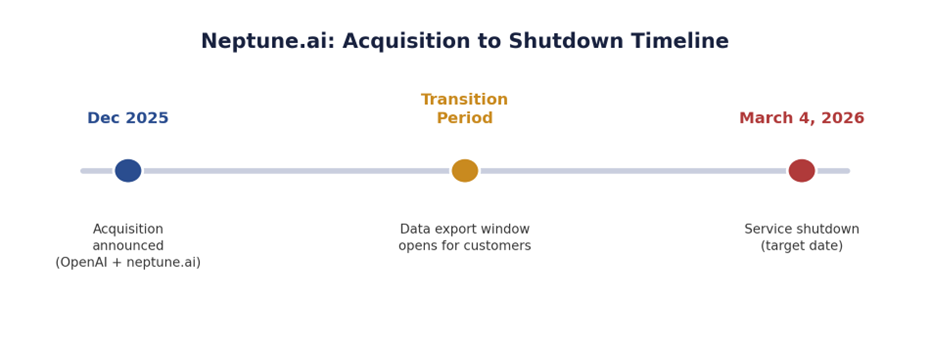
Neptune.ai, the Warsaw-based ML experiment tracking platform, was acquired by OpenAI, with the deal announced in early December 2025.
Its standalone paid service is being wound down, with a shutdown target of March 4, 2026. Old pricing plans no longer apply to new commitments. The real question now: what’s your replacement going to cost?
What Neptune AI Used to Cost
- Free tier — Available for individuals and small projects, with limited usage
- Individual/small team plans — Reportedly $10 to $35/month, per third-party review sites
- Team and enterprise tiers — Listed elsewhere at $150 to $600/month, depending on seats, storage, and logging volume
Why This Question Doesn’t Matter Anymore
OpenAI entered into a definitive agreement to acquire Neptune, a Warsaw-based startup that builds monitoring and debugging tools AI companies use while training models, with the deal announced in December 2025.
Following the deal, Neptune founder said the company would wind down its external, hosted service over the following months, giving existing customers a transition period to export their data and migrate to alternative tools.
In practical terms, there’s no long-term Neptune AI pricing plan left to compare. New sign-ups are closed. The relevant question isn’t what Neptune charges. It’s what the replacement will cost, and what migration will cost in engineering time.
What It Actually Costs to Replace Neptune AI
Based on publicly available information about the leading alternatives teams are migrating to, here’s the landscape.
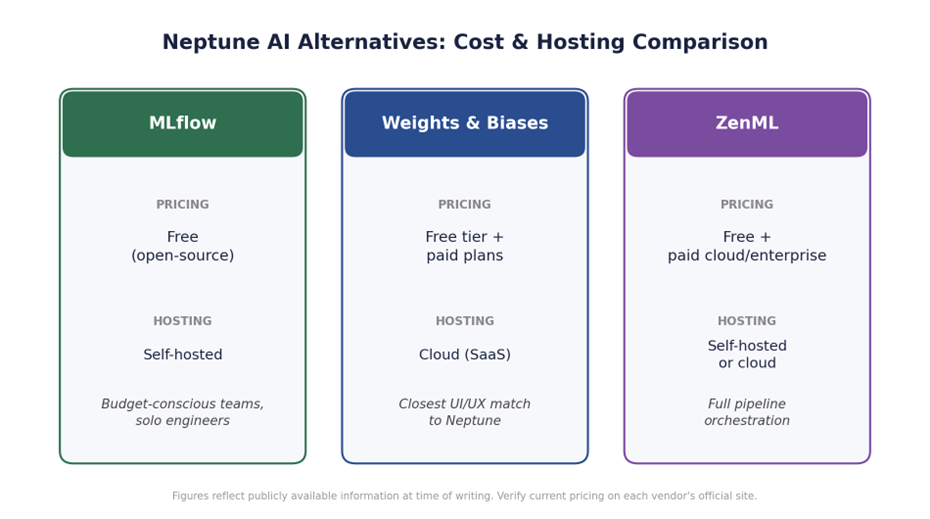
| Tool | Pricing | Hosting | Best For | Migration Effort |
| MLflow | Free (open-source) | Self-hosted | Budget-conscious teams, solo engineers | Medium — you manage infra |
| Weights & Biases | Free tier + paid plans | Cloud (SaaS) | Closest UI/UX match to Neptune | Low — similar workflow |
| ZenML | Free + paid cloud/enterprise | Self-hosted or cloud | Teams needing full pipeline orchestration | Medium–High |
Migration Costs You’re Not Budgeting For
Swapping logging calls from Neptune’s SDK to a new tool’s SDK is usually the easy part. What actually blows budgets:
What Actually Costs Time & Money During Migration:
- Rebuilding historical run comparisons and dashboards that don’t export cleanly
- Retraining team members on a new tool’s UI mid-project
- Rewriting custom integrations built against Neptune’s API
- Re-validating experiment logs for compliance or audit trails
If You’ve Outgrown “Just Tracking” Experiments
Neptune.ai in its legacy form was purpose-built for one job: logging and comparing ML training runs. If that’s genuinely all you need, MLflow, Weights & Biases, or ZenML above are the right comparison set, and price per seat is the deciding factor.
But if what you’re actually trying to solve is broader (routing tasks across multiple AI models like GPT-4, Claude, and Gemini, chaining them into workflows, and getting outcomes delivered automatically instead of just logged and charted) that’s a different category of tool entirely. Experiment trackers were never built to do it.
That’s the gap Neptune AI at neptuneai.live is built for: an AI orchestration platform, not an experiment tracker.
Neptune AI vs neptuneai.live: Are They the Same?
neptune.ai (Warsaw, being acquired by OpenAI) and Neptune AI at neptuneai.live (AI orchestration platform) are separate, unrelated businesses that happen to share a similar name.
| neptune.ai (Warsaw) | Neptune AI (neptuneai.live) | |
| What it does | ML experiment tracking | AI workflow orchestration across GPT-4, Claude, Gemini |
| Status | Being acquired by OpenAI, shutting down | Active, independent company |
| Pricing | N/A (discontinued) | Free / $15/mo Basic / $29/mo Pro |
| Use case | Logging and comparing training runs | Routing tasks and automating multi-model workflows |
It is not affiliated with neptune.ai and isn’t a drop-in replacement for its experiment-tracking features. It’s worth a look specifically if your actual pain point is getting AI models to do things and report back, not getting better charts of your training runs.
Current Neptune AI (neptuneai.live) pricing includes a Free plan with limited credits, a Basic plan at $15/month, and a Pro plan at $29/month with marketplace and workflow monetization features.
Ready to automate AI workflows instead of just tracking experiments?
FAQs
Is Neptune AI still free to use?
The legacy Neptune.ai experiment tracker had a free tier, but new sign-ups are closed as the platform winds down ahead of its March 2026 shutdown. It is not a viable option for new projects.
How much does Neptune AI cost per month now?
There is no current public pricing to sign up under, since the service is being discontinued. Historical published rates ranged from roughly $10 to $35/month on entry tiers, up to $150 to $600/month on team and enterprise tiers, though we can’t confirm which figure reflects Neptune’s final pricing.
What happens to my Neptune AI subscription after the shutdown?
Neptune has indicated data will not be recoverable after shutdown. Export your run history, metrics, and artifacts before the deadline rather than waiting on the platform itself.
What’s the cheapest Neptune AI alternative?
MLflow is free and open source if you’re willing to self-host. Paid alternatives like Weights & Biases and ZenML offer free tiers with paid upgrades as usage grows.
Is Neptune AI at neptuneai.live the same company as neptune.ai?
No. Neptune.ai, the Warsaw-based experiment tracker being acquired by OpenAI, and Neptune AI at neptuneai.live, the AI orchestration platform, are separate, unrelated companies that happen to share a similar name.