
Multi-Model AI Routing Choose the Best AI Model Automatically
Each AI task has an optimal model. However, many businesses make the mistake of choosing one model for all requests, regardless of whether the task requires GPT-4’s reasoning, Claude’s language precision, or Gemini’s speed. This results in excessive costs, varying levels of output quality, and disruptions to workflows when a single provider experiences downtime.
Neptune AI offers a solution through its intelligent multi-model AI routing. Through real-time analysis of each task, the platform automatically chooses the appropriate AI model, ensuring optimal output and cost efficiency without any manual intervention required on your part.
What Is Multi-Model AI Routing?
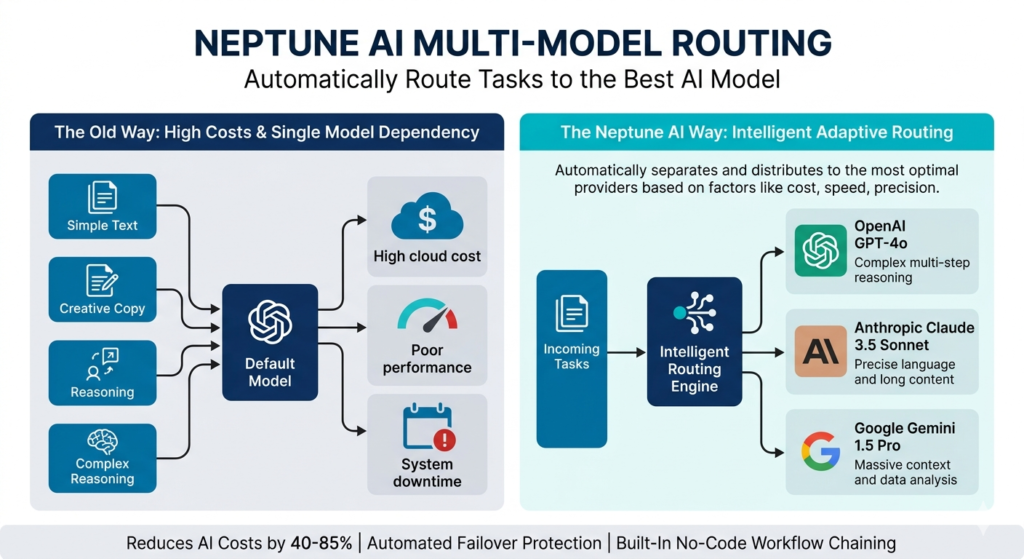
Multi-model AI routing involves directing AI requests to the most appropriate model based on the task at hand, rather than being restricted to a single default provider.
A routing layer acts as a bridge between your workflow and multiple AI providers, such as GPT-4, Claude, and Gemini. It determines in real time which model is best suited to handle each request. This determination is based on various factors such as task difficulty, budget limitations, time constraints, provider availability, and desired output quality standards.
The business impact is substantial, as research consistently demonstrates that adopting intelligent routing, rather than relying on a single model, can result in AI cost reductions of 40–85%, while maintaining or even enhancing output quality. This approach directs simpler tasks to lighter and more efficient models, while ensuring that complex reasoning tasks receive the necessary depth. Ultimately, every request is paired with its ideal match.
Neptune AI goes beyond the standard routing platform by not only selecting the optimal model, but also following through with the execution of the workflow and delivering the results through various communication channels such as WhatsApp, email, Slack, or SMS.
Why Manual Model Selection Does Not Scale
If your team is manually selecting the AI models for each task, you are already falling behind.
The market for AI models has seen a significant growth and now offers a wide range of options. Numerous LLMs from various providers have emerged, each designed to excel in specific tasks, context window sizes, cost structures, and output formats. GPT-4o stands out for its ability in complex multi-step reasoning, while Claude 3.5 Sonnet is known for producing accurate and well-structured language output. Gemini 1.5 Pro efficiently handles large context tasks. Moreover, smaller and faster models are available at a lower cost compared to the top-of-the-line models, making them suitable for classification, formatting, and extraction needs.
Effectively assigning tasks to the correct model among these choices is not feasible on a large scale. This demands ongoing involvement from engineers, extensive familiarity with the capabilities of each model, and frequent adjustments whenever a provider introduces a new model or alters their pricing.
Neptune’s routing engine utilizes intelligent multi-model AI technology to automate the decision-making process. It evaluates each task as it comes in and automatically selects the most optimal model, ensuring that your workflows run smoothly without any need for manual intervention.
How Neptune AI’s Intelligent Model Routing Works
The architecture of Neptune’s routing system is divided into three stages, each one enhancing the intelligence of the previous.
Phase: 1
Neptune utilizes customizable rules to assign specific models to handle different types of tasks. For instance, code generation tasks are directed to models specifically designed for programming output, while language-heavy tasks are routed to models with exceptional writing accuracy. Likewise, time-sensitive tasks are automatically assigned to the fastest provider available. These rules are established just once and apply seamlessly to all workflows.
Phase: 2
As the number of workflows increases, Neptune’s routing engine adjusts to reflect actual usage patterns. It takes into account the most effective models for your specific workflows, usual types of requests, and quality standards. The router evolves according to data from your live traffic, rather than generic benchmarks.
Phase: 3
At its most advanced level, Neptune implements a meta-AI component which coordinates routing choices for intricate, multi-step procedures. This component comprehends not only the immediate task at hand, but also its role within a broader automated workflow – modifying model selection according to downstream dependencies, linked API calls, and anticipated output criteria for every step.
With this three-phase structure, Neptune’s routing will continuously enhance its intelligence, consistently improving the selection of models for each workflow.
Neptune’s AI models determine the optimal routes between various destinations.
Neptune AI currently utilizes intelligent routing across three main AI providers, with the routing engine automatically selecting the optimal choice for each task.
OpenAI’s GPT-4o is renowned for its capabilities in intricate reasoning, solving multi-step problems, extracting structured data, and tackling tasks that demand a vast understanding of the world.
Anthropic’s Claude 3.5 Sonnet is the ideal choice for generating precise and nuanced language, creating longer content, summarizing information, and handling safety-sensitive tasks.
The Gemini 1.5 Pro by Google excels in handling large context window tasks, document analysis, and workflows that demand in-depth understanding of lengthy input.
You do not have to choose between these models with Neptune’s routing engine. It automatically selects the appropriate one for the task at hand.
Expanding Further than Routing: Complete Workflow Implementation
While several AI routing platforms, such as OpenRouter, LiteLLM, and Portkey, only focus on the routing layer and simply pass the request through a chosen model, the subsequent actions are ultimately up to you.
Neptune AI sets itself apart by viewing routing as the initial stage in an automated workflow, rather than its concluding step.
Once the routing engine has chosen the appropriate model and it produces its output, Neptune’s workflow execution layer kicks in. It then connects the AI output with other APIs, implements business logic, and initiates subsequent actions in your automated sequence – all without the need for manual interference.
Once the workflow has finished, Neptune’s communication agents will transmit the end result through your preferred channel of communication, whether it be WhatsApp, email, Slack, or SMS.
The complete architecture of Neptune, comprising of routing, execution, and delivery, sets it apart from a mere routing proxy. It goes beyond simply choosing the most suitable model and instead manages your entire AI-driven business workflow from start to finish.
When comparing Neptune to other AI routing platforms, it stands out for its unique features and capabilities.
Feature | Neptune AI | OpenRouter | LiteLLM | Portkey |
|---|---|---|---|---|
| Automatic model selection | ✅ | ✅ | ✅ | ✅ |
| Multi-provider support | ✅ | ✅ (600+) | ✅ (100+) | ✅ |
| No-code workflow builder | ✅ | ❌ | ❌ | ❌ |
| Workflow chaining & execution | ✅ | ❌ | ❌ | ❌ |
| Communication delivery (WhatsApp, email, Slack) | ✅ | ❌ | ❌ | ❌ |
| Adaptive routing intelligence | ✅ | ❌ | ❌ | ❌ |
| Built for business users (non-technical) | ✅ | ❌ | ❌ | Limited |
| Platform fee per request | ❌ | 5.5% | ❌ | Managed cost |
What sets Neptune apart from its competitors is not its extensive model catalog or its minimal proxy overhead. Rather, it stands out as the sole platform that can seamlessly route, execute, and deliver complete AI workflows within a single integrated system.
Who requires the utilization of multi-model AI routing?
Utilizing intelligent model routing is a crucial asset for organizations that operate multiple AI-driven workflows.
Teams handling customer communication, lead follow-up, and content generation workflows can streamline their operations through routing methods that automatically assign the appropriate model to each output type. This eliminates the need for manual management of API configurations.
For those overseeing AI workflows for multiple clients, a routing layer that automates model selection is crucial in order to streamline workflow output without increasing engineering complexity.
For those creating AI-based products, it is crucial to have a routing system in place that can handle provider failures, model upgrades, and cost optimization without the need for manual updates whenever there are changes in the model landscape.
As businesses continue to grow and seek to incorporate AI into various departments, they require a platform that can efficiently distribute tasks. This means avoiding a system that relies on a single model and charges steep fees for all requests regardless of their complexity.
Intelligent routing leads to tangible results for businesses.
Multi-model AI routing is not just a theoretical concept; rather, its impact on business outcomes can be accurately measured.
By implementing intelligent routing rather than single-model setups, organizations have reported significant cost reductions (ranging from 40-85%) for mixed workloads. Not only does this free up budget previously allocated for simpler tasks, but it also leads to improved output quality as each task is assigned to the most suitable model rather than relying on a default configuration. Additionally, reliability is enhanced through automatic failover between providers, reducing any potential downtime caused by outages from a single provider.
Neptune’s clients not only experience these benefits, but they also go beyond them. This is because the outcomes of their workflows go beyond simply improved AI responses; they result in actual business actions being executed through appropriate communication channels.
Frequently inquired information
Multi-model AI routing refers to the use of artificial intelligence in managing various transportation models.? Multi-model AI routing is the algorithmic process of assigning AI tasks to the most suitable model from a selection of providers, taking into consideration task category, expense, efficiency, and desired level of accuracy. Rather than directing all requests to one model, a routing layer evaluates each one and allocates it to the most suitable model for optimal performance.
What factors does Neptune AI consider when selecting a model? The routing engine of Neptune considers the type, complexity, and requirements of each task before choosing the most suitable model from GPT-4o, Claude 3.5 Sonnet, or Gemini 1.5 Pro. With increased workflow usage on the platform, the routing logic adjusts accordingly by utilizing real data from your unique workflows.
Is it possible to utilize multi-model routing without the need for coding? Indeed, Neptune AI is a no-code solution equipped with a visual workflow builder. This advanced tool allows you to set up comprehensive multi-model routing and automate workflows without the need for programming.
In the event that an AI provider goes down, what will occur? Neptune’s routing engine is equipped with automated failover capabilities. In the event that a provider is not accessible, the router will redirect the request to the next most suitable model, ensuring uninterrupted workflows.
What sets Neptune apart from both OpenRouter and LiteLLM? OpenRouter and LiteLLM serve as routing gateways, selecting a model to forward requests. Meanwhile, Neptune AI acts as a comprehensive AI orchestration platform, handling task routing, executing full workflows and delivering outcomes through your desired communication channel. It is more than just a simple routing proxy.
Does Neptune AI support communication delivery after routing? Indeed, once a workflow finishes, Neptune’s messaging agents automatically send the result via WhatsApp, email, Slack, or SMS without requiring any manual actions.
Is intelligent AI routing exclusively utilized by large corporations? Neptune AI offers a Free Plan with a starting price at $0/month, making it accessible to businesses of all sizes. This means that the level of routing intelligence will also adjust accordingly to your workflow volume.
Automate the process of assigning routing tasks to the appropriate AI model.
End the cycle of overspending on AI by relying on a single model for every request. Let Neptune AI’s advanced routing technology choose the most suitable model for each task, automatically and consistently, eliminating the need for any manual intervention on your end.
Streamline your route and enhance your execution speed to achieve successful outcomes on all the channels your company utilizes
Schedule a complimentary consultation.
Located in Delaware, USA, Neptune AI provides businesses across the United States with global AI orchestration solutions through its product and operations teams.