
Managing multiple AI models sounds simple until production hits. You suddenly need to handle routing logic, fallback mechanisms, cost limits, and cross-channel delivery without rebuilding your infrastructure every week. An AI control plane solves this by giving you a centralized system to direct traffic across providers, manage workflow execution, and maintain strict governance. You can cut costs and improve output quality by routing every request to the exact model designed for that specific task.
Key Takeaways
- An AI control plane serves as the central command layer for multi-model AI management.
- Intelligent model routing reduces AI costs by 40 to 85 percent by matching tasks to the most efficient provider.
- The average enterprise currently runs 5 to 12 models across departments, making centralized AI governance a structural necessity.
- Gartner projects the agentic orchestration market will reach $550B, highlighting a massive shift toward autonomous AI systems.
- The Neptune no-code AI control plane routes tasks across GPT-4o, Claude 3.5 Sonnet, and Gemini 1.5 Pro while automating workflow execution.
What is an AI control plane?
An AI control plane is a centralized architecture that governs, routes, and monitors AI workflows across multiple models and environments. Relying on a single AI provider works for prototypes but fails in enterprise production. A control layer sits between your applications and the AI models to direct requests automatically. This ensures every prompt reaches the best possible model based on capability, cost, and latency.
Without a control plane, developers hardcode model connections directly into applications. This creates technical debt. Once a new, cheaper model is released, your team has to rewrite code to take advantage of it. An AI control plane decouples the application from the model. It handles the API connections, token tracking, and error handling in the background. That is the reason modern engineering teams treat the control plane as mandatory infrastructure.
Why do growing AI teams face orchestration problems?
Integrating AI APIs looks straightforward until usage scales. Your engineering team suddenly spends hours updating endpoints, managing token limits, and fixing broken prompts when a single provider goes down. What begins as a simple OpenAI integration quickly turns into a fragile system of tangled logic.
Most companies make the mistake of sending every request to their most capable, most expensive model. They use a heavyweight reasoning model to perform basic text classification. This creates bloated cloud bills and slow response times. Furthermore, single-provider dependency introduces massive risk. If your chosen AI provider experiences an outage, your entire application goes offline.
Scaling AI requires multi-model AI management. Different tasks require different model strengths. Some tasks need advanced reasoning, while others only need fast formatting. Managing these conditional logic paths manually becomes impossible once your product grows.
What exactly does an AI control plane manage?
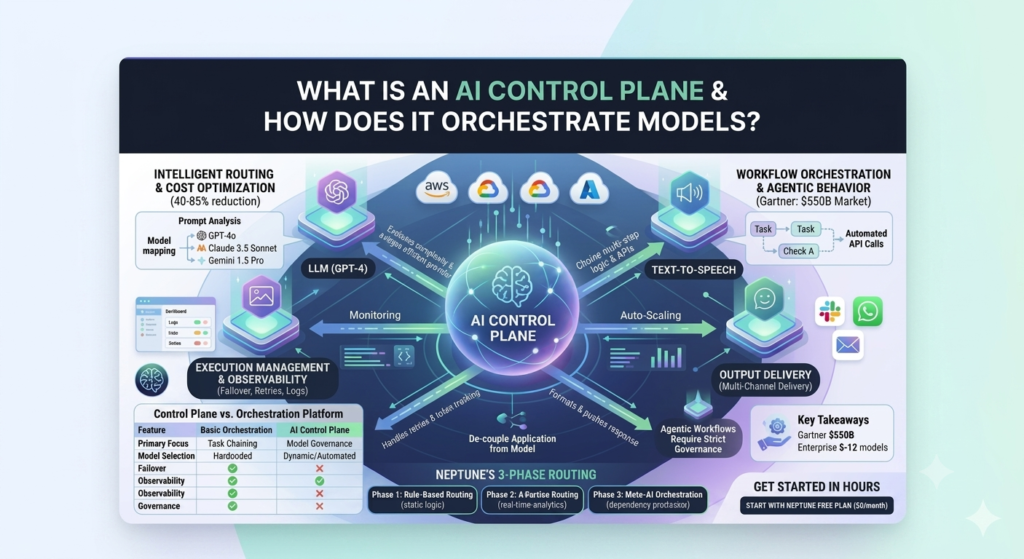
A complete AI control plane handles four primary functions. It does not just route prompts. It manages the entire lifecycle of an AI request from input to final delivery.
- Intelligent model routing: The control plane evaluates the complexity of a prompt and assigns it to the most efficient provider.
- Workflow orchestration: It chains multiple AI models and external APIs together to execute complex, multi-step business logic.
- Execution management: The system monitors the execution of tasks, handles retries for failed API calls, and provides AI observability for logging and debugging.
- Output delivery: It formats the final AI response and pushes it to end-user communication channels like Slack, WhatsApp, or email.
How does an AI control plane compare to an orchestration platform?
Many vendors use orchestration and control plane terminology interchangeably. There is a distinct architectural difference between the two concepts. Choose a control plane if governance and routing matter more than simple task automation.
| Feature | Basic Orchestration Platform | AI Control Plane |
|---|---|---|
| Primary focus | Chaining tasks and APIs | Governing models, routing, and system execution |
| Model selection | Hardcoded by the developer | Dynamic and automated via routing engines |
| Failover handling | Manual retry logic | Automated fallback to secondary models |
| AI observability | Limited to basic success/fail logs | Comprehensive token, cost, and latency tracking |
| Governance | Minimal role access | Strict policy enforcement and usage limits |
Why are AI control planes a business requirement today?
Building custom routing logic sounds viable until you realize how quickly the AI landscape changes. Models are updated, deprecated, and re-priced every few months. The average enterprise runs 5 to 12 models across departments. Managing these connections individually creates isolated silos of data and unpredictable costs.
Gartner projects the agentic orchestration market will reach $550B. This projection illustrates a massive industry shift. Companies are moving away from simple chatbots and toward autonomous systems that execute business processes. These agentic workflows require strict AI governance. Without a control plane, organizations have no centralized way to audit which models are making decisions or how much data is leaving the corporate network.
Teams that skip the control layer experience slower development cycles. Engineers spend their time maintaining API connections instead of building product features. An AI control plane removes this burden entirely.
How does Neptune’s AI control plane route and execute tasks?
Neptune is a no-code AI control plane built to orchestrate complex operations without requiring developer maintenance. Most platforms only serve as an API proxy. Neptune is different because it manages routing, logic execution, and communication delivery in a single platform.
The Neptune routing engine evaluates each task and selects from top-tier models. The platform natively supports GPT-4o by OpenAI for complex reasoning, Claude 3.5 Sonnet by Anthropic for precise language generation, and Gemini 1.5 Pro by Google for large context window tasks.
Neptune handles AI model routing in three distinct phases.
Rule-based routing
Early workflows rely on static rules. You can configure Neptune to always send code generation tasks to GPT-4o and all document summarization tasks to Claude 3.5 Sonnet. This ensures immediate predictability for your baseline operations.
Adaptive routing
Once your workflows process more data, Neptune shifts to adaptive routing. The engine analyzes live traffic, historical latency, and success rates. It automatically routes requests based on real-time availability and cost efficiency. This is how intelligent routing reduces AI costs by 40 to 85 percent.
Meta-AI orchestration
For highly complex operations, Neptune uses a meta-AI layer. This layer understands the downstream dependencies of a multi-step workflow. It predicts which model will produce the exact formatting required for the next step in the chain, ensuring smooth execution across disjointed systems.
How does Neptune compare to other AI orchestration tools?
Evaluating AI orchestration vendors looks confusing until you map out exactly what each platform executes. Many legacy automation companies have rebranded as AI orchestration tools. You should always verify if a platform actually handles intelligent routing or just hardcodes API calls.
| Platform | Core Architecture | Best Use Case | Limitations |
|---|---|---|---|
| Neptune AI | No-code AI control plane | Cross-model routing and automated delivery | Focused heavily on autonomous workflows rather than custom coded apps |
| IBM watsonx Orchestrate | Enterprise conversational AI | HR and customer service automation | High setup complexity and enterprise pricing |
| Microsoft Azure Copilot Studio | Microsoft ecosystem integration | Teams and SharePoint automations | Heavy vendor lock-in to Azure services |
| UiPath Maestro | RPA agentic automation | Legacy system scraping and bot coordination | Deeply tied to legacy UiPath architecture |
| AWS AgentCore | Developer infrastructure | Custom agent building via code | Requires heavy engineering resources |
| LangGraph | Open-source framework | Code-first multi-agent systems | No visual builder or out-of-the-box delivery |
Which industries build workflows on Neptune?
General automation tools can work for MVPs, but production-scale products usually need specialized execution. Neptune provides the architecture required for strict operational environments.
- Software as a Service (SaaS): Product teams use Neptune to route user queries in the background. They avoid vendor lock-in and keep infrastructure costs low by routing simple tasks to cheaper models.
- Financial Services: Fintech companies require strict AI governance. They use the control plane to route sensitive data extraction tasks to highly secure models while keeping audit logs intact.
- Healthcare and Logistics: Operations teams utilize Neptune to parse massive medical documents. They rely on Gemini 1.5 Pro for its large context window, managed entirely through Neptune’s routing engine.
- Marketing Agencies: Agencies use the Neptune no-code AI control plane to automate content generation. The system routes copy requests to Claude 3.5 Sonnet and automatically delivers the final drafts to client Slack channels.
How do you get started with the Neptune no-code platform?
Setting up AI workflow orchestration manually can easily consume weeks of engineering time. Neptune reduces setup time to a few hours using a visual builder.
- Create your environment: Sign up for the Neptune Free Plan at $0/month. This tier allows you to test routing capabilities before committing to enterprise scale.
- Define your workflow triggers: Set up the events that initiate your AI tasks. This can be an incoming email, a database update, or a webhook from your application.
- Configure model routing: You do not need to configure API keys for every provider. Use the visual builder to establish your rule-based or adaptive routing preferences across GPT-4o, Claude, and Gemini.
- Attach communication agents: Select where the final output should go. Neptune can automatically push the processed data to WhatsApp, SMS, or internal dashboards.
Frequently asked questions
What makes an AI control plane different from an API gateway?
An API gateway simply forwards a request to a designated endpoint. An AI control plane actively evaluates the request, selects the best model dynamically, monitors the execution, and manages fallback logic if a provider fails.
How does intelligent model routing actually reduce costs?
Hardcoding every request to a premium model like GPT-4o wastes money on basic tasks. Intelligent model routing analyzes the prompt and sends simple formatting or extraction tasks to cheaper, faster models. This optimization cuts overall token spend by 40 to 85 percent.
Does the Neptune platform require custom code to orchestrate workflows?
No. Neptune is a no-code AI control plane. You construct workflows, define routing rules, and set up communication agents using a visual interface. This allows operations teams to deploy AI without waiting for engineering resources.
How does Neptune handle provider outages?
Single points of failure ruin production applications. If an AI provider experiences downtime, Neptune automatically triggers fallback logic. The routing engine seamlessly redirects the prompt to the next most capable model, ensuring your workflow completes without user interruption.
Can small businesses afford agentic orchestration technology?
Enterprise platforms charge massive implementation fees. Neptune offers a Free Plan at $0/month. This allows startups and small teams to implement intelligent routing and cross-channel delivery without upfront capital.
What are the next steps for scaling AI orchestration?
Building custom routing logic is a massive waste of engineering resources. As the market moves toward autonomous agentic workflows, relying on a single AI provider is a structural liability. Your applications require a dedicated layer to manage traffic, control costs, and enforce governance.
That is the biggest reason developers prefer centralized orchestration. By decoupling your application logic from your AI providers, your team can customize faster and scale without rebuilding infrastructure. Implement a control layer today to ensure your AI operations survive the realities of production.