
What is AI communication agents? Artificial intelligence has a delivery problem.
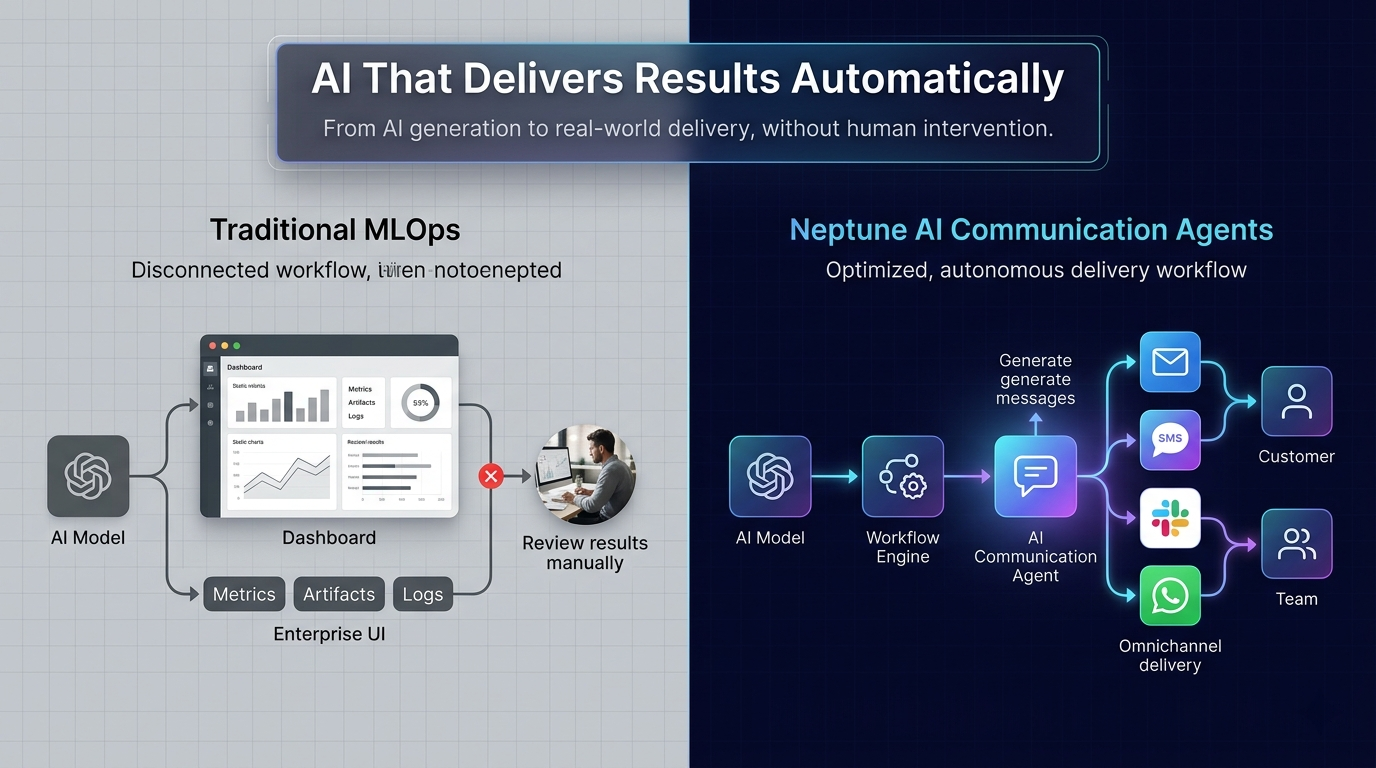
Every major MLOps platform, Neptune.ai (now shut down), MLflow, ZenML, Weights & Biases, was built to track what AI produces. Log the metrics. Store the artifacts. Visualize the results.
None of them delivers the results to anyone.
This is the gap that AI communication agents fill. They are the final step in an autonomous AI workflow, the layer that takes what the AI produced and delivers it to the right person, on the right channel, at the right time. Without human intervention.
AI that generates results but cannot deliver them has not finished the job.
Neptune’s communication agents finish the job.
What Are AI Communication Agents?
AI communication agents are autonomous software components that deliver AI-generated outputs through real-world communication channels, email, SMS, WhatsApp, Slack, webhooks, and push notifications, as steps within a larger AI workflow.
They are not chatbots. They are not notification tools bolted onto an existing system. They are native workflow components that operate with full access to the data produced by every upstream AI step in the workflow.
The distinction matters:
| Concept | What it does | Communication Agent? |
| Chatbot | Responds to user messages in a conversation interface | No, reactive, not autonomous |
| Notification tool (e.g. Twilio) | Sends pre-written messages triggered by events | No, no AI, no workflow context |
| Zapier notification step | Sends a templated message when a trigger fires | No, not AI-native, no dynamic content |
| AI Communication Agent (Neptune) | Generates context-aware messages from AI workflow outputs and delivers them autonomously across channels | Yes, fully autonomous, AI-native |
The core differentiator: an AI communication agent has access to the full context of the workflow that produced the output. It doesn’t send a templated message, it generates or adapts the message based on what the AI produced, who needs to receive it, and what channel they use.
The Missing Layer: Why AI Stops at Generation
Look at how every major experiment tracking and MLOps platform, the tools neptune.ai users are now migrating to, describes their core function:
- neptune.ai (shut down): log metrics, compare runs, store artifacts
- MLflow: track experiments, package models, manage the ML lifecycle
- ZenML: build reproducible ML pipelines, manage metadata, orchestrate on Kubernetes
- Weights & Biases: visualize training, compare experiments, collaborate on results
Every single one of these platforms ends at the output. The AI runs. The result is stored. Someone has to go look at it.
This made sense in 2018–2023, when AI was primarily a research activity. Researchers needed to compare experiments and analyze results. They went to look at the dashboard.
In 2026, AI is a production activity. It runs customer support workflows. It generates campaign content. It processes orders. It produces reports. In production AI, the output has to go somewhere, to a customer, a team member, a system, or an external service.
The platforms MLflow and ZenML built for research-era AI are not equipped for this. They have no communication layer. They never needed one.
Neptune does. Because Neptune was built for production AI, not research AI.
How Neptune’s Communication Agents Work
Communication agents in Neptune are configured as workflow steps, placed at the point in the workflow where delivery needs to happen. They are not afterthoughts. They are first-class workflow components.
Each communication agent step has three components:
1. Context Access
The agent has access to the complete output of every upstream workflow step — the raw AI outputs, processed data, conditional results, and any external API responses. This is what enables dynamic, context-aware communication rather than templated notifications.
Example: a customer support workflow generates a detailed response draft. The communication agent receives the draft, the customer’s name, their account tier, the original ticket category, and the sentiment score, and uses all of this to compose a personalized delivery.
2. Content Composition
The agent composes the message content. This can be:
- Direct delivery of AI-generated content, the workflow produces the message, and the agent sends it as-is
- Dynamic template filling: the agent populates a channel-specific template with workflow output data
- AI-assisted composition, a lightweight model adapts the workflow output for the specific channel and recipient (shortening for SMS, formatting for Slack, structuring for email)
3. Channel Delivery
The agent delivers across the configured channel, or multiple channels simultaneously. Neptune supports:
| Channel | Primary Use Cases | Key Capability |
| Customer responses, reports, approvals, campaigns, digests | HTML formatting, attachments, CC/BCC, reply-to | |
| SMS | Urgent alerts, order updates, OTPs, time-sensitive notifications | Character optimization, link shortening, carrier routing |
| B2C customer support, order tracking, personalized follow-ups | Rich media, template messaging, session management | |
| Slack | Team alerts, workflow status, escalations, and daily digests | Channel routing, thread replies, interactive blocks |
| Webhooks | System integrations, external workflow triggers, API callbacks | Custom headers, payload templating, and retry logic |
| Push Notifications | Mobile app alerts, re-engagement, and real-time updates | Deep linking, segmentation, and scheduled delivery |
AI Communication Agent Use Cases by Industry
Communication agents solve a specific problem in every industry that uses production AI. Here are the highest-value applications:
E-commerce
- Abandoned cart recovery: AI analyzes cart contents and customer history → generates personalized recovery message → communication agent delivers via email + WhatsApp within 30 minutes of abandonment
- Order update chains: Fulfillment system triggers workflow → AI generates context-aware status update → agent delivers via SMS (urgent) + email (detailed) simultaneously
- Review request automation: Purchase confirmed → AI generates personalized review request based on product category and customer segment → agent delivers via email at optimal send time
Marketing Agencies
- Campaign performance alerts: AI monitors campaign metrics → detects anomaly or milestone → communication agent alerts account manager via Slack + sends detailed report to client via email
- Content approval workflows: AI generates campaign copy → routes to human review via email with one-click approval → on approval, agent triggers publication workflow
- Client reporting: AI aggregates and analyzes performance data → generates narrative insights → agent delivers formatted report via email every Monday morning, automatically
SaaS / Developers
- Automated customer onboarding: User signs up → AI personalizes onboarding sequence → communication agent delivers day 1, day 3, day 7 emails with context-specific tips based on user behavior
- Usage-based alerts: AI monitors account usage → predicts approaching limits → agent proactively notifies customer via email before they hit the wall, with upgrade options
- Support ticket triage: Ticket submitted → AI classifies urgency and routes to the appropriate team → agent notifies the assigned team member via Slack with full ticket context
Gaming
- Player re-engagement: AI identifies churning players by behavior patterns → generates personalized re-engagement message → delivers via push notification + email with custom offer
- Community event notifications: Event created → AI personalizes notification based on player preferences and history → agent delivers via push + Discord webhook simultaneously
Creator Economy
- Audience milestone alerts: AI monitors subscriber counts and engagement → detects milestone → generates celebratory message → agent notifies creator via email + posts to Discord community
- Sponsorship follow-ups: Pitch sent → AI monitors response time → if no response in 48 hours, generates follow-up → agent delivers via email with updated pitch
AI Communication Agents vs Chatbots: Why They Are Not the Same
The most common misconception about AI communication agents is that they are a type of chatbot. They are not. The distinction is architectural, not cosmetic.
| Dimension | Chatbot | AI Communication Agent |
| Trigger | User initiates conversation | Workflow step completes |
| Direction | Bidirectional, responds to input | Outbound delivers output |
| Context | Conversation history | Full workflow execution context |
| Autonomy | Reactive, waits for input | Autonomous, executes on schedule or trigger |
| Channel | Typically, one (chat interface) | Multi-channel simultaneously |
| Content | Generated in response to the user message | Generated or adapted from workflow output |
| Use case | Customer service, Q&A, support | Outcome delivery, alerts, follow-ups, reports |
| Requires human? | Yes, humans must initiate | No, fully autonomous end-to-end |
Chatbots wait. Communication agents act.
In a well-designed AI workflow, both have a role: chatbots for inbound customer interaction, and communication agents for autonomous outbound delivery. Neptune’s platform supports both, and they can coexist within the same workflow.
Building Closed-Loop AI Workflows
A closed-loop AI workflow is one where the AI doesn’t just process a task, it completes it, including delivery of the outcome to whoever needs it.
The loop:
- Task arrives: From a user, a schedule, or an external trigger
- AI processes: One or more models handle the task via Neptune’s routing layer
- Workflow executes: Multi-step chaining handles any additional processing, validation, or transformation
- Communication agent delivers: The outcome reaches the right person or system via the right channel
- Loop closes: The task is complete without human intervention at any step
This is fundamentally different from what every MLOps tool, Neptune.ai, MLflow, and ZenML, was built to do. Those platforms closed the loop at step 3. The output was produced and stored. Steps 4 and 5 were left to the user.
Neptune closes all five steps.
Omnichannel AI Communication: One Workflow, Every Channel
One of Neptune’s core communication capabilities is simultaneous multi-channel delivery, a single workflow step that delivers to multiple channels at once, with channel-appropriate formatting for each.
Example: a weekly AI-generated business performance report workflow:
- Email: Full report with charts, tables, and narrative analysis delivered to the CEO and board
- Slack: A concise three-bullet summary with key metrics posted to the #leadership channel
- SMS: A single headline metric sent to the CEO’s phone for at-a-glance review
- Webhook: Structured JSON payload sent to the BI dashboard for automatic update
One workflow. One trigger. Four simultaneous deliveries. Four different formats. Zero human involvement.
No competitor in the MLOps or AI workflow space, not ZenML, not MLflow, not Weights & Biases, offers this natively. It requires building and maintaining four separate integration systems, or paying for a separate omnichannel communication platform.
Neptune provides it as a native workflow step.
Frequently Asked Questions
What are AI communication agents?
AI communication agents are autonomous workflow components that deliver AI-generated outputs through real-world channels, email, SMS, WhatsApp, Slack, webhooks, and push notifications. They operate as steps within larger AI workflows, with full access to workflow context, enabling dynamic and personalized delivery without human intervention.
How are AI communication agents different from Zapier or Make.com notifications?
Zapier and Make.com send templated notifications triggered by events. Neptune’s communication agents are AI-native; they have access to the full output of every upstream AI model and workflow step, enabling genuinely dynamic content. They also compose content using AI models when needed, not just populate a fixed template.
Which communication channels does Neptune support?
Neptune communication agents support email, SMS, WhatsApp, Slack, webhooks, and push notifications. Multiple channels can be triggered simultaneously from a single workflow step, with channel-appropriate formatting for each.
Can I use Neptune’s communication agents without the full workflow engine?
Neptune is designed as an integrated platform; communication agents are most powerful as part of a full workflow. However, Neptune’s API allows direct triggering of communication agents from external systems. Contact the Neptune team for standalone communication API access details.
Do communication agents work with existing customer data?
Yes. Communication agents can be configured to pull customer data from external APIs or databases as part of the workflow, enabling personalization based on CRM data, purchase history, user preferences, or any other structured data source your team manages.
Is Neptune’s communication layer GDPR compliant?
Neptune’s platform is built with data governance controls, including per-workflow data residency settings, audit logging, and configurable data retention policies. For specific GDPR compliance requirements, the Neptune enterprise team can provide a detailed compliance review.
Getting Started with AI Communication Agents
Every AI team building production workflows will eventually need autonomous communication. The question is whether to build it separately, wiring up Twilio, SendGrid, Slack APIs, and WhatsApp Business APIs individually, or to use a platform where communication is a native workflow component.
Neptune’s communication agents are available in the free tier. No credit card required.
- Create your account at NeptuneAI.live
- Build or choose a workflow template for your use case
- Add a communication agent step at the end of your workflow
- Configure your channel, email, SMS, WhatsApp, Slack, or webhook
- Run your first fully autonomous, closed-loop AI workflow
Start building at NeptuneAI.live, free tier, no credit card required.