
Quick answer: If you’re comparing AI orchestration and automation platforms for a US-based business in 2026, the eight names that come up most are Zapier, Make, n8n, Workato, Lindy AI, Gumloop, Relevance AI, and Tray.ai. Most of them bill on tasks, operations, executions, or credits transparent at first, expensive at scale. Neptune AI takes a different approach: it routes each task automatically to the best AI model (GPT-4o, Claude 3.5 Sonnet, or Gemini 1.5 Pro), chains that output into a full workflow, and delivers the finished result to WhatsApp, Slack, or email on a flat monthly plan starting at $0. Below is a full, feature-by-feature breakdown so you can pick the right tool instead of guessing.
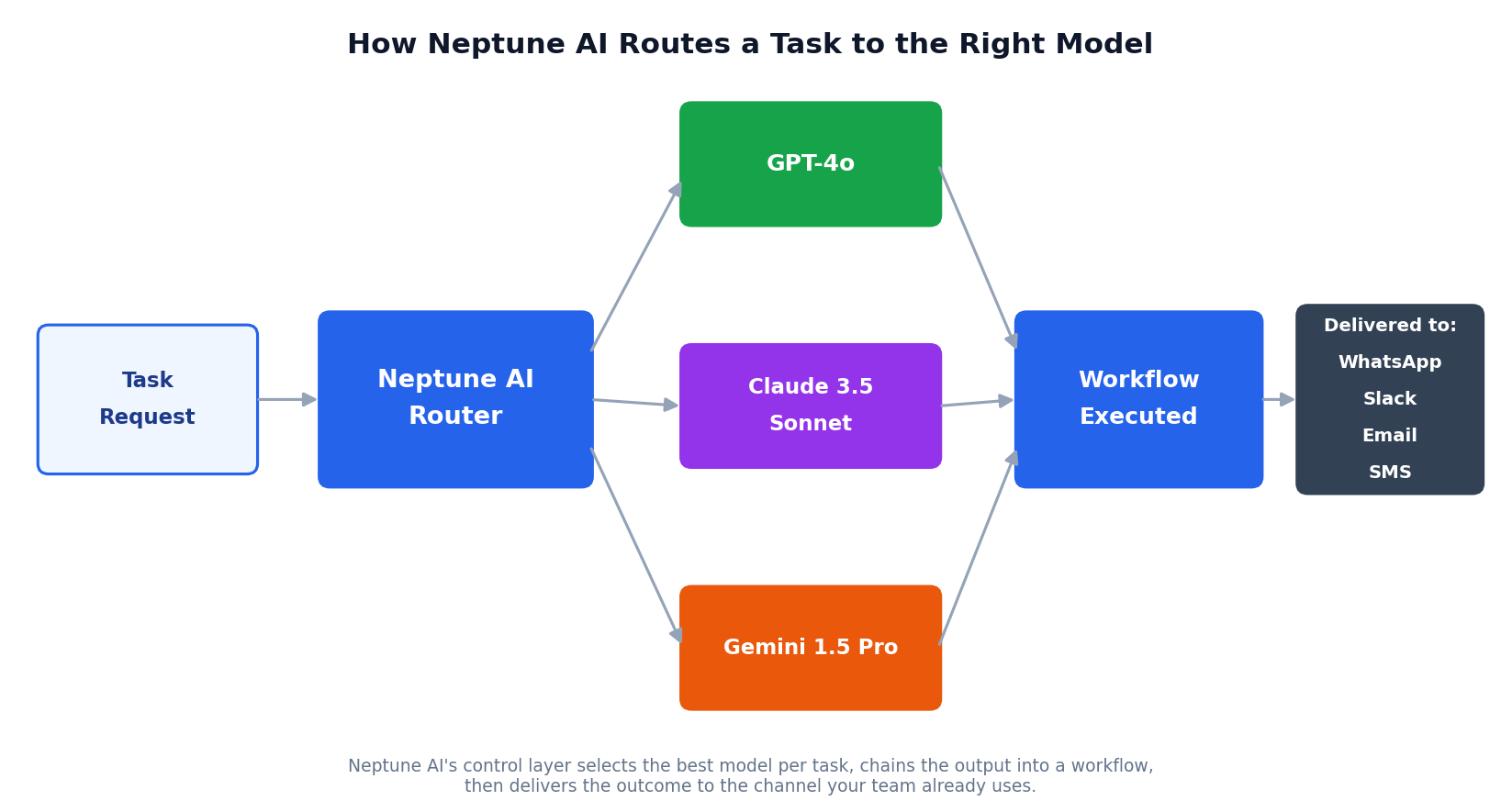
How Neptune AI routes a task to the right model, then delivers the finished outcome to your team’s communication channels.
Table of Contents
Why This Comparison Matters Right Now
Every one of these platforms will tell you it’s “AI-powered.” Very few of them actually decide which AI model should handle a task. Most automation tools Zapier, Make, n8n started as connector platforms: trigger an event in App A, push data to App B. AI got bolted on later as a feature inside that pipe.
Neptune AI was built the other way around. It sits above the models and APIs as a control layer, automatically routing each task to GPT-4o, Claude 3.5 Sonnet, or Gemini 1.5 Pro based on what the task actually needs, then chains that decision into a full workflow and hands the finished output to a communication agent that pushes it to WhatsApp, Slack, email, or SMS.
That’s the core distinction to understand before you pick a tool: are you buying a connector platform with AI features, or an AI routing layer that also automates your workflow and delivers the result?
What to Look for Before You Buy
Before picking any tool on this list, weigh it against these five factors they’re the ones that actually predict whether a platform pays for itself:
- Pricing model — Flat subscription vs. usage-based (tasks, operations, executions, or credits). Usage-based pricing looks cheap on the landing page and gets expensive the moment your workflows scale.
- Model routing — Does the platform pick the right AI model per task automatically, or do you manually wire every step to one model?
- Delivery, not just automation — Does the tool just move data between apps, or does it actually deliver a finished outcome to a channel your team already checks (Slack, WhatsApp, email)?
- No-code accessibility — Can a non-technical operator build and maintain the workflow, or does it require a developer on standby?
- Predictable total cost — Add up the base plan plus realistic overage before you commit; this is where most teams get surprised.
Neptune AI vs. 8 Top Competitors: Comparison Table
| Platform | Core Model | Starting Price | Pricing Type | Best For |
|---|---|---|---|---|
| Neptune AI | Multi-model AI orchestration + communication delivery | $0 (Free), $15/mo (Basic), $29/mo (Pro) | Flat subscription | Businesses that want AI model routing and outcomes delivered to WhatsApp/Slack/email, not just app-to-app automation |
| Zapier | Connector automation (9,000+ apps) | Free (100 tasks); paid plans generally $20–$30/mo, scaling per task tier | Per-task, tiered | Teams needing the widest app integration library for simple automations |
| Make (Integromat) | Visual scenario builder | Free (1,000 credits/mo); paid from ~$9/mo | Per-operation/credit | Mid-market teams wanting granular visual control at lower cost than Zapier |
| n8n | Open-source workflow automation | Free self-hosted; Cloud from ~$20–24/mo | Per-execution or self-hosted | Developer-led teams that want infrastructure control and LLM/RAG pipeline support |
| Workato | Enterprise integration & automation | Custom (platform + usage) | Platform + usage-based | Large enterprises with complex, cross-system, mission-critical workflows |
| Lindy AI | AI agent builder (“digital employees”) | Plus from ~$49.99/mo, no permanent free tier | Flat plan + credit usage | Teams wanting pre-built AI agents for inbox, scheduling, and voice tasks |
| Gumloop | Visual AI workflow canvas | Free (2,000 credits); Solo from ~$37/mo | Credit-based | Teams building data-heavy pipelines, scraping, enrichment, content generation |
| Relevance AI | Multi-agent “AI workforce” builder | From ~$19/mo (individual) to ~$199/mo (team) | Tiered subscription + usage | Sales/ops teams coordinating multiple collaborating agents |
| Tray.ai | Low-code enterprise automation | Custom enterprise pricing | Custom/enterprise | Large orgs needing developer-grade API and JSON control |
Pricing reflects publicly reported rates as of mid-2026 and changes frequently always confirm current numbers on each vendor’s pricing page before purchasing.
Platform-by-Platform Breakdown
Neptune AI vs. Zapier
Zapier is the category leader on integration breadth, connecting more apps than anyone else on this list. But it was built for rules-based, trigger-and-action automation, not AI model orchestration Zapier itself has said as much by adding AI fields as an add-on rather than a routing core. It also bills per task, and every step inside a multi-step Zap consumes its own task, which is the single most common complaint teams have once they scale past a handful of workflows.
Where Neptune AI Differs
Neptune automatically decides which AI model handles a task (GPT-4o for one step, Claude for another), then delivers the finished outcome directly to a communication channel something Zapier doesn’t do natively. And Neptune’s plans are flat, so a workflow that runs 500 times doesn’t quietly multiply your bill the way a Zapier task count does.
Neptune AI vs. Make (Integromat)
Make gives you more visual control than Zapier at a lower entry price, with a drag-and-drop scenario builder that handles branching, iterators, and error handling well. It’s a strong choice for operations teams that want to see every data path. The tradeoff is the same category as Zapier, though: Make is a connector and automation tool first, billed by operations consumed, not an AI orchestration layer that routes work across models.
Where Neptune AI Differs
Neptune isn’t just connecting your apps it’s deciding which AI model is best suited to each task in the chain and executing the full workflow autonomously, then pushing results to your team’s actual communication channels.
Neptune AI vs. n8n
n8n is the developer’s choice: open-source, self-hostable, and priced by workflow execution rather than by step, which makes it cheaper than Zapier or Make for complex, multi-step automations. It has real strength in LangChain integration and RAG pipeline building. The cost is technical overhead someone on your team needs to manage the infrastructure, or you pay for n8n Cloud.
Where Neptune AI Differs
Neptune is no-code from the ground up, with a visual workflow builder that doesn’t require a developer to configure or maintain. If your team wants AI orchestration without hiring an engineer to run it, Neptune removes that requirement entirely.
Neptune AI vs. Workato
Workato is built for enterprise-grade, mission-critical automation across large, complex systems, with reusable “recipes” and strong API management. It’s a serious platform but it’s priced and built for enterprise IT teams managing dozens of cross-department integrations, with custom platform-plus-usage pricing that typically requires a sales conversation.
Where Neptune AI Differs
Neptune is accessible to SMBs and mid-market teams at a published $0–$29/month price point, no sales call required, while still offering the workflow-chaining depth smaller AI-native platforms often skip.
Neptune AI vs. Lindy AI
Lindy builds pre-configured AI “digital employees” for tasks like inbox triage, scheduling, and voice calls, with a large template library that gets non-technical users running fast. It’s genuinely strong at autonomous, event-triggered agent work. The catch reported across multiple 2026 pricing reviews is a “credit economy” problem: the advertised plan price ($49.99–$199.99/month) often understates the real bill once voice minutes and high-frequency workflows are added, and Lindy no longer offers a permanent free tier.
Where Neptune AI Differs
Neptune has a genuine free plan and flat-fee paid tiers, so the price you see is closer to the price you pay. Neptune also routes across GPT-4o, Claude, and Gemini rather than committing to a single underlying model per agent.
Neptune AI vs. Gumloop
Gumloop is a visual, node-based canvas built for data-heavy work scraping, enrichment, and turning unstructured content into structured outputs. It’s a solid pick for content and research operations. Pricing is credit-based, and multiple 2026 comparisons note that credit consumption varies by which AI model a step calls, which makes total monthly cost harder to predict in advance.
Where Neptune AI Differs
Neptune’s model routing is automatic and built into the core product rather than a per-step credit decision you have to manage manually, and the flat subscription model avoids the credit-forecasting problem entirely.
Neptune AI vs. Relevance AI
Relevance AI focuses on multi-agent coordination building a team of AI agents that work together which suits sales and ops use cases with several moving parts. It’s flexible but has a steeper learning curve for teams new to multi-agent design, and pricing scales from roughly $19/month for individuals up to $199/month for team plans as usage grows.
Where Neptune AI Differs
Neptune’s routing intelligence (it explicitly describes a three-phase evolution from rule-based to adaptive to meta-AI orchestration) handles the model-selection complexity for you, so you don’t need to hand-design agent coordination logic to get multi-step AI workflows running.
Neptune AI vs. Tray.ai
Tray.ai is a low-code platform aimed at developers who need deep API and JSON-level control inside enterprise automation. It’s powerful for technical teams but not designed as a no-code, business-user-facing tool, and pricing is custom enterprise-only.
Where Neptune AI Differs
Neptune is built for business users first a visual, no-code builder that still chains APIs and models into autonomous workflows, without requiring developer resources to operate day to day.
The Real Cost Comparison: Flat Pricing vs. Usage-Based Billing
This is the part most comparison articles skip, and it’s the part that actually affects your bottom line. Look back at the table above: six of the eight competitors here Zapier, Make, n8n, Lindy AI, Gumloop, and Relevance AI bill by tasks, operations, executions, or credits. Independent 2026 pricing breakdowns of Zapier, Lindy AI, and Gumloop each flag the same pattern: the advertised entry price is real, but the bill grows fast once a workflow runs at production volume, and multi-step workflows can multiply costs in ways that are hard to predict from the pricing page alone.
Neptune AI’s Free, Basic ($15/month), and Pro ($29/month) plans are flat subscriptions. For a US small business or growing SaaS team that wants to budget AI automation the same way it budgets any other software line itemna fixed number, not a variable one that’s a meaningful difference, not a marketing line.
Who Should Actually Choose Neptune AI
Neptune AI is the strongest fit if you are:
- A US-based SaaS, agency, or SMB that wants AI tasks routed to the right model automatically, instead of manually choosing GPT-4, Claude, or Gemini for every workflow step
- A team that wants outcomes delivered where your business already communicates WhatsApp, Slack, or email — not just data moved silently between two apps
- An operator who wants a no-code visual builder, not a developer-dependent, self-hosted setup
- A business that wants predictable monthly software costs instead of a usage-based bill that can spike without warning
- A developer or agency that wants to build and monetize workflow chains, automation bundles, or vertical AI solutions on a marketplace layer, not just run private automations
If your only requirement is connecting two SaaS apps with a simple trigger, Zapier or Make will still get that done. If you want an AI orchestration layer that decides how the work gets done and delivers the result, that’s the gap Neptune AI is built to close.
Frequently Asked Questions
Is Neptune AI a Zapier alternative?
Yes. Neptune AI routes tasks to GPT-4o, Claude 3.5 Sonnet, or Gemini automatically and adds multi-agent coordination plus communication delivery across WhatsApp, email, Slack, and SMS capabilities Zapier doesn’t offer natively as a rules-based connector platform.
What’s the difference between an AI orchestration platform and a workflow automation tool?
A workflow automation tool (Zapier, Make, n8n) moves data between apps based on triggers and rules. An AI orchestration platform like Neptune AI additionally decides which AI model should handle each task, chains that decision across a full workflow, and can execute autonomous, multi-step outcomes rather than a single trigger-action pair.
Does Neptune AI require coding?
No. Neptune AI is a no-code platform with a visual workflow builder, so workflows can be configured without writing code.
Which AI models does Neptune AI support?
Neptune AI currently routes tasks across GPT-4o (OpenAI), Claude 3.5 Sonnet (Anthropic), and Gemini 1.5 Pro (Google), automatically selecting the model suited to each task type.
Is there a free AI orchestration platform for small businesses?
Neptune AI offers a Free plan ($0/month) with feature restrictions and limited credits, making it accessible for small businesses or teams testing AI orchestration before upgrading to Basic ($15/month) or Pro ($29/month).
How is Neptune AI priced compared to competitors?
Neptune AI uses flat monthly subscriptions ($0 / $15 / $29). Most competitors on this list Zapier, Make, n8n, Lindy AI, Gumloop, and Relevance AI use usage-based pricing (tasks, operations, executions, or credits), which several independent 2026 pricing analyses note can significantly exceed the advertised entry price at production volume.
Try Neptune AI Before You Commit to a Usage-Based Plan
If you’re evaluating these platforms because a competitor’s bill just spiked, or because you’re tired of manually deciding which AI model to use for each task, start with Neptune AI’s Free plan and see the model routing and communication delivery in action before you commit to a usage-based competitor.
Book a Free Consultation | View Pricing | Get Started
Competitor pricing and feature information in this article reflects publicly available data as of mid-2026, gathered from vendor pricing pages and independent comparison sources. Pricing changes frequently confirm current rates directly with each vendor before purchasing.